
Write the next blog post
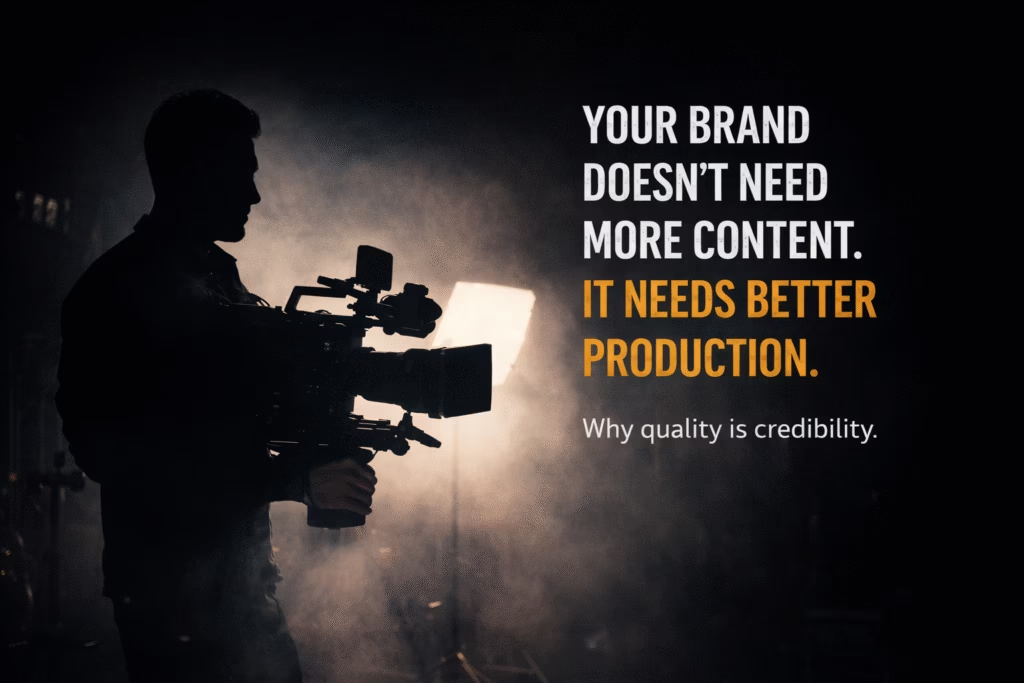
Most brands treat media production like a camera problem. They think the fix is a better lens, a newer phone, a sharper 4K look, a trendy LUT, or some editor who can throw flashy cuts on top of weak footage. That is the fastest way to burn money while still looking cheap. Because your brand doesn’t need “more content.” It needs content that feels intentional, consistent, and credible. And credibility is what good production actually buys you.
The brutal truth is that audiences judge quality in seconds, and they judge it unfairly. They don’t care that you’re a startup. They don’t care that you’re “still building.” They don’t care that your budget is limited. They just see what’s in front of them and decide what you’re worth. When your visuals look sloppy, your sound is messy, your lighting is flat, and your framing is random, people don’t think, “Oh, they’re new.” They think, “This is amateur.” And that assumption leaks into everything else. Your pricing feels overpriced. Your offer feels risky. Your promises feel exaggerated. Your brand feels like it’s trying too hard.
Media production is not about making things pretty. It’s about making things believable.
A high-quality product presented with low-quality production gets treated like a low-quality product. That’s how perception works. Humans take shortcuts. We use signals. We assume that what we see reflects what we’ll experience. That’s why luxury brands obsess over visuals and why serious companies don’t publish content that looks like it was filmed accidentally. If you want to be taken seriously, your output has to look like you are serious.
This is where most content marketing collapses. Businesses pump out volume because they were told consistency matters. They post every day, every other day, three times a week, whatever the schedule is. The problem is that consistency without quality is just consistent damage. You keep teaching the audience that you’re not worth attention. You keep repeating the same first impression. You keep reinforcing the idea that your brand is “small-time.” And then you wonder why you have followers but no buyers, views but no leads, likes but no trust.
Production is what turns content into an asset instead of a chore. When production is done right, your content becomes reusable, repurposable, and durable. One well-produced shoot can feed multiple platforms, multiple formats, multiple campaigns. It can carry your message for months. When production is done badly, content becomes disposable. It dies in 24 hours and leaves you scrambling for the next post like you’re feeding a monster that never gets full.
The first mistake is thinking production equals equipment. Equipment is the last thing that matters after you’ve nailed the fundamentals. Lighting, sound, composition, and direction beat expensive cameras every day. A clean, well-lit shot on a mid-range camera will crush a poorly lit shot on a cinema rig. Clear audio will win over beautiful visuals with noisy sound. Bad sound is the quickest way to make a brand feel cheap because it triggers discomfort. People won’t always say, “The audio was bad,” but they’ll feel the irritation and exit. It’s unconscious. It’s immediate.
The second mistake is making content without a message architecture. Many brands shoot “cool videos” with no strategic purpose. They film behind-the-scenes because it’s easy. They film random testimonials with no structure. They film reels with generic advice because everyone else is doing it. It might look good, but it doesn’t move anything. Media should not be random. Media should be built on a system of what the brand needs to prove: credibility, differentiation, outcomes, process, personality, and proof. Every piece of content should be doing a job, not just filling a slot.
The third mistake is confusing “creative” with “chaos.” A lot of brands chase cinematic vibes and forget clarity. They prioritize style over communication. The viewer ends up impressed for three seconds and then confused. If your content is confusing, it’s not premium. It’s just unclear. Premium brands are often simple. They’re direct. They guide attention. They make the viewer feel safe because the message is controlled.
Real media production is a pipeline. It has stages that protect quality and protect time. Pre-production is where you win. It’s where you decide what you’re shooting, why you’re shooting it, what the narrative is, what the angles are, what the shots are, what the locations are, who is on camera, what wardrobe fits the brand, what the tone is, what references you’re using, what the deliverables will be, and how this content will be repurposed. If pre-production is sloppy, production day becomes a mess. You waste hours. You miss shots. You capture unusable audio. You end up patching holes in editing. That’s where budgets disappear.
Production day is execution, not improvisation. You’re capturing controlled reality. Lighting is set for the mood you want. Audio is captured clean. Framing is deliberate. Talent is directed. Shots are planned. Coverage is intentional. And most importantly, you’re capturing content for multiple uses, not one video. A smart production day produces: hero videos, short clips, stills, behind-the-scenes, cutdowns, hooks, and vertical versions. A dumb production day produces one “main video” and a few scraps that don’t fit anywhere.
Post-production is where the brand identity becomes consistent. Editing is not just cutting clips. It’s pacing, rhythm, sound design, color, typography, subtitles, and structure. It’s deciding what stays, what goes, and what the viewer must feel by the end. This is where many brands get lazy and kill their own credibility. They slap on random fonts. They use inconsistent subtitle styles. They shift colors from video to video. They use loud, mismatched music. The result is a brand that looks like five different companies depending on which post you saw first.
Consistency is a form of trust. If your content feels consistent, people assume your business is consistent. If your content feels random, people assume your service is random. That’s the link most businesses ignore.
There’s also the problem of “production for production’s sake.” Some teams overproduce content that doesn’t match the buying context. A beautifully shot cinematic video can be completely wrong for a product that needs clarity and quick proof. Sometimes the best production decision is not making it fancy. It’s making it sharp. Sometimes you need clean studio lighting and straightforward delivery. Sometimes you need documentary-style authenticity. Sometimes you need polished commercial visuals. The right production choice depends on what the customer needs to believe before they pay.
And that brings us to the real role of media production for a business: it accelerates belief. It shortens the time it takes for a stranger to trust you. Good production doesn’t guarantee sales, but it removes friction. It stops the audience from getting distracted by amateur signals. It lets the message land. It makes your pricing feel justified. It makes your brand feel established. It makes your offer feel safer. In competitive markets, that’s not a luxury. That’s survival.
If you want to test whether your brand needs better production, don’t ask, “Does this look nice?” Ask a colder question: “Does this make us look expensive or cheap?” “Does this increase trust or raise suspicion?” “Does this make the viewer feel confident or uncertain?” People buy when they feel confident. Production is one of the fastest ways to engineer that confidence.
And no, this isn’t a call to chase perfection. Perfection is another trap. The goal is not to look like a Hollywood studio. The goal is to look deliberate. Controlled. Professional. Like you know what you’re doing. Like you respect your own brand. Like you’re not begging for attention. Like you’re building something real.
Because once you understand this, you stop chasing “content.” You start building a media system. And that’s when your brand stops being just another page posting into the algorithm and starts looking like a business people actually want to trust.
3 Responses
hubiqi testing
12
qqq