
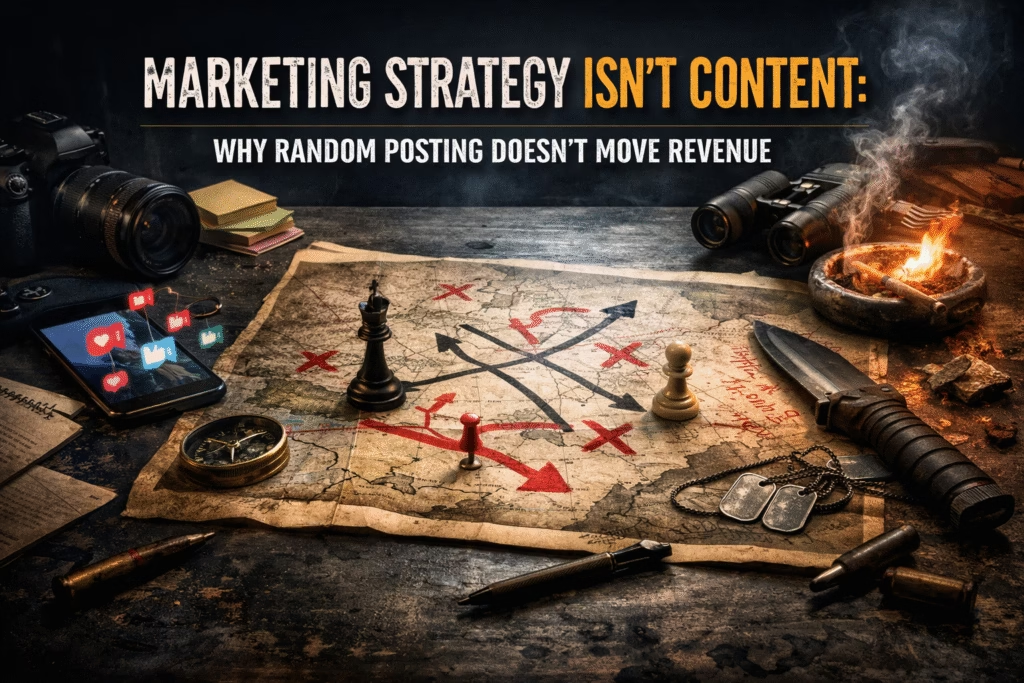
Most brands think marketing is content. Post more, design cleaner, chase trends, crank out reels, stay “consistent.” That’s the religion. And it’s exactly why most businesses stay stuck in the same loop: attention spikes, ego metrics rise, and revenue barely moves. Because content is not a strategy. Content is the output. Strategy is the system that decides what the output must do, who it must move, and why it should work.
A marketing strategy is not a calendar. It’s not a vibe. It’s not “we’re focusing on TikTok this quarter.” Strategy is a set of decisions that forces your business to stop being vague. It locks you into a specific buyer, a specific problem, a specific promise, and a specific way of winning. Without that, content becomes a slot machine. You keep pulling the lever, hoping this next post finally hits. Sometimes it does. Most of the time it doesn’t. And even when it “goes viral,” it often attracts the wrong crowd. People who clap, not people who pay.
The first job of strategy is to pick the fight. That means choosing who you are for and who you are not for. Most brands avoid this because it feels like “losing customers.” In reality, trying to speak to everyone is how you become forgettable to the people who actually matter. A real target audience isn’t “men and women 18–45” or “anyone who likes quality.” That’s a demographic soup. Your strategy needs a buyer with a clear situation, clear urgency, clear constraints, and clear motivations. Someone with a problem that costs them time, money, reputation, comfort, or opportunity. When that’s clear, marketing stops being creative guesswork and becomes applied psychology.
Then strategy decides your position. Positioning is the place you want to occupy in the customer’s mind when they’re deciding. Not when they’re scrolling bored at midnight, but when they’re about to spend. If you don’t control that mental slot, you get compared on price or convenience, and that’s where margins go to die. Your positioning should make you the obvious choice for a specific type of customer. Not “we’re the best.” Not “we offer high quality.” Everyone says that. Positioning is the sharp claim that frames what you do and why it matters in a way competitors can’t easily copy. It’s the difference between being one of many options and being the option that makes sense for a certain kind of buyer.
After that comes the offer. Most businesses have weak offers because they sell what they do, not what the customer gets. They list services like a menu and expect the buyer to connect the dots. But buyers don’t pay for effort. They pay for outcomes, risk reduction, speed, certainty, and transformation. If your offer isn’t designed to be bought, no amount of content will fix it. Content can attract attention, but it can’t rescue a confusing, generic, poorly framed offer. If people don’t understand what changes in their life after they pay you, you will constantly have to shout for attention. A strong strategy forces the offer to be clear, valuable, and credible before you start decorating it with reels and captions.
Then strategy designs the route from attention to purchase. This is where most “content-first” brands collapse. They assume people see a post and immediately buy. That’s not how most markets work. People move through stages. They notice you, then they get curious, then they compare, then they hesitate, then they need proof, then they need a reason to act now, then they need reassurance that they won’t regret it. Strategy maps that journey. It decides what needs to be said at each stage and what proof needs to exist for the buyer to step forward. Content is supposed to serve that journey, not replace it. If your content doesn’t lead somewhere, it’s entertainment. If it leads somewhere badly, it’s frustration. If it leads somewhere clearly, it becomes leverage.
Channels come next, and this is where the delusion gets loud. Not every platform is right for every business, even if the platform is “hot.” Strategy chooses channels based on buyer behavior and intent, not hype. Some markets need search because intent is high and people actively look for solutions. Some markets need community and trust. Some markets need visual proof. Some need credibility signals and long-form explanation. If you pick channels because you like them or because everyone else is there, you’re building your business on a trend instead of a system. Strategy makes channel decisions boring and logical. Content makes them emotional and reactive.
Finally, strategy defines measurement in a way that doesn’t allow self-deception. Most brands track what’s easiest to see: views, likes, followers. Those are not meaningless, but they’re not success. Success is movement in business outcomes: qualified leads, conversion rate, customer acquisition cost, average order value, lifetime value, retention, and referral. Strategy decides which numbers matter, how they’re tracked, and what “good” looks like. Without that, you end up celebrating noise and ignoring leaks. You feel productive while the business stays the same.
So when someone says, “We need content,” what they often mean is, “We need results and we don’t want to do the uncomfortable thinking that creates results.” Because strategy is uncomfortable. It forces trade-offs. It forces specificity. It forces you to admit that your message is vague, your offer is generic, your proof is weak, or your audience is poorly defined. Content is easier because it feels like action. Strategy feels like restraint. But restraint is exactly what creates power. When you stop trying to be everything to everyone, your marketing starts hitting like it’s supposed to.
None of this is saying content doesn’t matter. Content matters a lot. But content is a tool. If you don’t know what job the tool is supposed to do, you’ll keep swinging it at random and wondering why the wall doesn’t break. Strategy tells you where to strike, how hard, and with what. Content is the strike.
If your brand is posting consistently and still feels invisible, it’s not because you need more content. It’s because you’re producing output without a system. Fix the system and your content stops being a chore. It becomes a weapon that does its job: attract the right people, build belief, prove credibility, and drive action. That’s marketing. The rest is just noise with good lighting.
8 Responses
We hired HubiQi for a complete digital marketing strategy overhaul, and the results were impressive. Their SEO optimization and content marketing approach helped us rank on Google for competitive industry keywords within a few months. The ROI on our paid ads has doubled since implementing their PPC and conversion rate optimization strategies.
If you are serious about digital marketing, brand growth, and sustainable online visibility, HubiQi delivers. Their marketing strategy integrates SEO, PPC advertising, analytics tracking, and long-term growth planning.
Their expertise in search engine marketing and paid traffic campaigns helped us scale aggressively. Our lead generation cost reduced while overall revenue increased. HubiQi understands digital growth strategy.
The brand strategy and digital growth plan they developed positioned us strongly in our industry. Social media engagement and website traffic both increased significantly.
HubiQi’s data analytics and campaign tracking setup gave us clear insights into customer behavior. Our marketing decisions are now fully data-driven and performance-focused.
HubiQi completely transformed our social media marketing strategy. Their data-driven approach to Facebook Ads and Instagram Ads significantly improved our engagement rate and lead generation. If you are looking for performance marketing that actually converts, this is the team.
Heshan’s approach to digital marketing is sharp, analytical, and results-focused. HubiQi helped us scale through SEO optimization, Google Ads management, and full-funnel marketing strategy. The level of strategic thinking and execution we received was beyond what most marketing consultants offer.
Working with HubiQi was a strategic turning point for our company. What stood out most was Heshan’s clarity and depth in marketing strategy. He does not just run campaigns, he builds structured digital growth systems backed by SEO, paid advertising, analytics, and brand positioning. The leadership and vision behind HubiQi make it more than just a marketing agency. It is a performance-driven growth partner.